Protecting Your Aging Parents From Financial Scams Without Taking Away Their Independence

If you’re looking for ways to protect aging parents from financial scams, know that navigating the modern world of finance is no longer just about budgeting; it’s about defense.
If you are helping aging parents, you are probably already aware of how aggressive financial scams have become. Americans over 60 lost more than $3.4 billion to fraud in 2023, and that number keeps climbing. According to the FBI’s Internet Crime Complaint Center (IC3) data, in 2024 there was a total of $4.885 billion in losses from 147,127 complaints. This is a 46% increase in complaints from 2023, as well as a 43% increase in losses. hat makes this so hard is that scammers are not amateurs. They use rehearsed scripts, emotional pressure, and shared call lists. They sound professional, convincing, and urgent.
This is not about telling your parents to “be more careful.” That usually backfires. Instead, it is about putting quiet systems in place that protect them while preserving their dignity and independence. I like to frame these steps as safety upgrades, not restrictions. The goal is for them to stay in control, while you build a silent shield around their finances.
If you are also juggling paperwork, moving decisions, or sibling disagreements, you might recognize how all of this overlaps. Financial protection is not a standalone task. It connects directly to planning, documents, and family communication.
1. Put Protective Systems in Place Early
This works best when it feels collaborative, not corrective. These are guardrails, not lectures.
Create a family code word
Agree on a word or phrase only close family would know. If a caller claims there is an emergency involving a child or grandchild, that code word becomes the first checkpoint.
Adopt the “I’ll call you back” rule
Any urgent request involving money gets a pause. Hang up. Call back using a known number from a contact list or official statement. Real emergencies can wait five minutes.
Set up bank notifications
Many financial institutions can flag large or unusual transactions and notify a trusted contact. This provides early warning without daily interference.
Use transaction alerts and joint reviews
Automatic alerts for withdrawals and purchases make it easier to spot issues quickly. Reviewing statements together also opens the door for calm conversations instead of reactive ones.
Protect credit and property records
Freezing credit with major bureaus and monitoring property records helps prevent identity theft and deed fraud. These steps are especially important once downsizing or estate planning begins.
Many families wait to put these systems in place until something feels “off.” Unfortunately, by that point, scammers may already have momentum. Putting guardrails in place early removes pressure from future conversations. Instead of reacting emotionally, everyone knows the rules ahead of time.
These systems are not about mistrust. They are about clarity. When expectations are clear, parents don’t feel singled out, and adult children don’t feel like they are constantly watching for problems.
2. Use Technology to Reduce Scam Risk
Technology can act as a filter without making your parents feel watched.
Call-blocking and screening services
Caller ID tools and scam-blocking services dramatically reduce the number of fraudulent calls that ever get through.
Register numbers on the Do-Not-Call list
This will not stop scammers entirely, but it does cut down on legitimate marketing noise that can mask scam calls.
Real-time transaction alerts
Text or email alerts for large transactions allow you or another trusted person to verify activity quickly, before damage is done.
If your parents already feel overwhelmed by tech, this is a great place to help without judgment. You are not taking over, you are simplifying.
3. Know the Scams and the Subtle Warning Signs
Education matters, but it works best when it is specific.
Common scams targeting older adults include:
- Tech support scams, fake virus alerts that demand remote access
- Grandparent scams, urgent calls pretending to be a distressed grandchild
- Government impersonation, threats involving Social Security, Medicare, or the IRS

Read the Script: What the Scammer Will Say.
What is a common example of a 'Grandparent Scam' script?
The Script: “Hi Grandma, it’s me. I know I sound a little different, I’ve got a broken nose from the accident. I’m in [City] and I’ve been arrested. I’m in jail and I need you to wire money for bail immediately. Please don’t tell my parents; I’m so embarrassed and they’ll never trust me again.”
The 2026 Danger (AI Voice Cloning): Criminals now use AI to clone a grandchild’s voice from a 30-second clip of a video posted on social media. The caller won’t just sound like them; they will have the same pitch, accent, and speech patterns.
The New Red Flag: If the “grandchild” asks for money via wire transfer, cryptocurrency, or gift cards, it is a scam 100% of the time.
What is a common example of a 'Tech Support' scam script?
The Script: “This is Microsoft Security. We have detected a critical virus on your computer that is currently stealing your banking information and passwords. Do not turn off your computer or you will lose your data. I need you to download this ‘Secure Support Tool’ so I can fix this for you remotely.”
The 2026 Danger (Browser Hijacking): Scammers now use full-screen browser “locks” that play a loud alarm and display a fake blue screen of death. They often use AI-generated local accents to sound more “neighborly” and trustworthy.
The New Red Flag: No legitimate tech company will ever call you out of the blue or ask for remote access to your computer via a phone call.
What is a common example of a 'Government Impersonation' scam script?
The Script: “This is Agent Miller from the Social Security Administration. Your SSN has been linked to a drug trafficking and money laundering investigation. A warrant has been issued for your arrest. To protect your assets, you must move your funds into a ‘Government Safety Locker’ account immediately.”
The 2026 Danger (Deepfake Credentials): Scammers may ask the senior to switch to a video call, where they use a deepfake video of a person in a realistic-looking government office or uniform to “prove” their identity.
The New Red Flag: Government agencies will never threaten arrest over the phone or ask you to move your money to “safety” or pay via cryptocurrency.
What is a common example of a 'Romance Scam' script?
The Script: “I am so glad we found each other. I’m finishing up my contract work on the oil rig and I can’t wait to fly home to see you. But my bank account has been frozen due to a tax issue, and I don’t have enough for the flight. Could you help me just this once? I’ll pay you back as soon as I land.”
How it Works in Real Life: A younger, attractive person often initiates contact on social media or dating apps, posing as a “friend.” They spend weeks building an emotional bond through daily texts and photos. Once trust is established, they slyly pivot to asking for “startup funds” for a business project or a “can’t-miss” investment opportunity, making the senior feel like they are part of a shared future.
The 2026 Danger (AI Personalities): Scammers use AI chatbots to maintain 24/7 communication, learning the senior’s hobbies and family details to build an intense emotional bond much faster than a human could.
The New Red Flag: If an online “partner” or “friend” asks for money, financial help, or investment capital but repeatedly makes excuses for why they cannot meet in person or do a live (non-filtered) video call.
What is a common example of a 'Home Title Fraud' scam script?
The Script: “This is the County Records office. We are calling to notify you of a pending lien against your property due to an unpaid debt from ten years ago. If this is not settled by 5:00 PM today, your home will enter the foreclosure process. You can pay the processing fee now to halt the filing.”
The 2026 Danger (Digital Forgery): Scammers use AI to perfectly replicate the letterhead and signatures of local county officials, making their follow-up emails look identical to official government correspondence.
The New Red Flag: Property-related legal actions are handled via certified mail, not phone calls. Any demand for an immediate “stop-payment fee” over the phone is a scam.
What is a common example of a 'Package Delivery' scam script?
The Script: “U-P-S: Your package has a ‘Missing House Number’ and cannot be delivered. A $1.50 redelivery fee is required. Please click this link to update your address and pay the fee, or your package will be returned to the sender.”
The 2026 Danger (Data Enrichment): These links often install “Keyloggers” on a senior’s phone, which records them as they type in their actual banking passwords later that day.
The New Red Flag: Legitimate shippers will never text you to demand a fee for a package you didn’t specifically order or “route” through their official app.
What is a common example of a 'Utility Shut-off' scam script?
The Script: “This is the Billing Department at the Electric Company. Your account is 90 days past due. A technician is in your area right now to disconnect your power. To cancel the work order, you must pay the balance immediately using a digital payment app or a retail voucher.”
The 2026 Danger (Smart Meter Spoofing): Scammers can spoof the caller ID to look like the local utility company and may even know the senior’s actual street address, making the threat feel incredibly real.
The New Red Flag: Utility companies provide multiple written notices before disconnection and will never demand payment via Zelle, Venmo, or retail gift cards.
Watch for quieter red flags too. Sudden secrecy around finances, stacks of unopened mail, or repeated mentions of phone calls asking for personal information are worth paying attention to.
If something feels off, trust that instinct. Many adult children tell me they knew something was wrong long before they could explain it.
Rather than lecturing your parents, you can take proactive steps to protect aging parents from financial scams by framing these tools as ways for them to stay in control of their money and avoid the headaches of dealing with fraudsters.
I once spoke with a daughter who did everything “right.” Her mom was sharp, organized, and fiercely proud of her independence. One afternoon, she received a call claiming to be from Social Security. The caller knew her full name, her address, and even the last four digits of her Social Security number. It sounded official. It sounded urgent.
The caller told her there was a problem that needed to be resolved immediately or her benefits would be suspended. She was instructed not to talk to anyone else while it was being handled. Wanting to fix the issue quickly and avoid trouble, she followed the instructions.
By the time her daughter noticed something felt off and they compared notes, a large part of her Mom’s retirement savings was already gone.
What stuck with me was not the loss itself, but the aftermath. The mother was embarrassed. Not because she lacked intelligence, but because she had been put under emotional pressure designed to override common sense. It took time to rebuild confidence, and even more time to rebuild trust in herself.
That experience changed how their family approached financial safety. Instead of reacting to problems, they put simple guardrails in place. A rule to pause before any urgent financial request. Shared visibility into large transactions. Clear permission to double-check anything that felt even slightly off.
No one took control away from her. But everyone slept better.
Why These Scams Are So Effective
4. Use Practical Tools and Professional Backup
What makes these scams especially dangerous is not just the technology behind them, it’s the emotional pressure they apply. Scammers are trained to create urgency and fear. They push for secrecy. They discourage your parent from “bothering” family members or banks. All of this is intentional.
Many scams succeed because they bypass logic and go straight for emotion. Fear of arrest, fear of losing benefits, fear of letting down a grandchild in trouble. When someone is under stress, even smart, capable people can make decisions they would never make in a calm moment.
The emotional pressure scammers create is very real. Federal crime data shows that tech support fraud, government impersonation, investment scams, and other schemes are among the most commonly reported complaints by older adults. Scammers know that urgency, fear, and familiarity can override logical thinking, which is why even careful, organized parents can fall victim. Understanding how widespread these threats are helps families see that guardrails and conversations are not optional—they’re essential. [fbi.gov]
It’s also important to know that scammers are evolving quickly. Some are beginning to use AI-enhanced impersonation, including voice cloning and highly personalized messages that sound unsettlingly real. A call may sound exactly like a grandchild. An email may reference real details pulled from social media or public records. This does not mean your parent is careless if they are fooled. It means the tactics are getting more sophisticated.
That’s why prevention works best when it’s not just about spotting scams, but about slowing the moment down. Simple rules like calling back, using a family code word, or pausing before any money is sent create space for clarity. And that pause is often enough to stop a scam cold.
This is where structure really helps.
In Downsize with Dignity, Worksheet 4: Financial Access & Safety List walks families through documenting accounts, trusted contacts, and protection steps in one place. This is not busywork. It becomes invaluable during emergencies or transitions.
If you believe your parent is already being targeted or making unusual financial decisions, there are Financial Elder Abuse Specialists who work with banks and law enforcement to step in quickly.
Just as important, make sure a Durable Power of Attorney is in place while your parents are mentally competent. This is not about control. It is about having the legal authority to protect them if something unexpected happens. Waiting too long can leave families powerless at exactly the wrong moment.
Final Thought
Protecting your parents from financial scams is not about fear. It is about respect. You are safeguarding the life they built and the legacy they want to leave, while still honoring their independence.
Done thoughtfully, these steps do not feel like a loss of freedom. They feel like support. And in the long run, that quiet protection can save your family from stress, conflict, and irreversible damage.
Frequently Asked Questions About Protecting Aging Parents From Financial Scams
What are the first signs that a parent might be targeted by a financial scam?
Often it starts with subtle changes, not big losses. Look for unusual withdrawals, unopened mail piling up, or repeated mentions of phone calls that ask for personal info. These aren’t definitive proof of a scam, but they are reasons to gently check in and review recent activity together.
What should I do if I think my parent has already been scammed?
Time matters. Contact their bank or financial institutions immediately so suspicious transactions can be reversed if possible, and accounts can be frozen. Report the scam to the Federal Trade Commission (FTC) and Adult Protective Services in your state. An elder law attorney or a Financial Elder Abuse Specialist can help navigate recovery steps.
Is it okay to take over a parent’s finances if they keep getting scammed?
This is a delicate balance. Rather than taking over completely, think about systems that protect without eroding dignity. For example, setting up account alerts, real-time notifications, or view-only access. A Durable Power of Attorney (POA) can grant authority only if it’s truly needed. If the situation is urgent and independence is at risk, have a calm conversation with professional support.
Can technology tools like call blocking really help?
Yes. Scammers rely on repeated contact, so tools that screen calls, send unknown numbers to voicemail, or register numbers on the Do Not Call list all reduce the number of scam attempts that ever reach your parent. Combining these with digital alerts on financial accounts adds a quiet layer of protection without heavy monitoring.
How do I talk about financial safety without making my parent defensive?
Lead with empathy. Start general conversations about shared safety (e.g., “I got a weird scam call, have you seen anything like this?”). Use “we” language instead of “you” language, and position safeguards as tools to protect their independence and legacy, not limitations. Human-to-human connection always beats fear-based messaging.
How common is elder financial fraud, and who is most at risk?
Elder fraud is growing rapidly. In 2024, Americans over 60 reported over 147,000 fraud complaints totaling nearly $4.9 billion in losses, a Huge increase from the previous year. Seniors are often targeted because they are perceived as polite, trusting, financially stable, and less likely to report scams due to embarrassment or lack of awareness. Even careful, organized older adults can be vulnerable, which is why proactive protection, open family conversations, and safeguards are essential.
If this topic brought up concerns about your own parents, you’re not alone. Most families don’t realize how common these risks are until they start these conversations.
Want to Take the Next Step in Protecting Your Parents?
Conversations about money safety can feel overwhelming, especially when you are trying to balance independence with protection. Having the right information organized in one place makes those conversations calmer and far more productive.
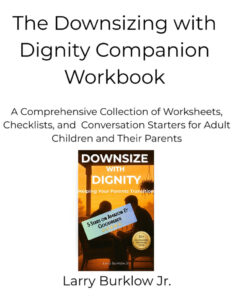
If you would like a simple way to start, the Downsizing Worksheets Companion Workbook includes a Financial Access & Safety List designed to help families document accounts, trusted contacts, and protection steps before a crisis happens.
You can access the worksheets here: [ Downsize with Dignity Companion Workbook ]
If you are navigating bigger transition conversations, you may also find guidance in Downsize with Dignity: Helping Your Parents Transition, which walks through the emotional, legal, and practical sides of supporting aging parents.