
"I'm Not Moving." — What To Do When Aging Parents Refuse to Downsize

When aging parents refuse to downsize, most adult children try harder. That's usually the problem.
Carol had been trying for two years.
Every visit home to her parents’ four-bedroom house in suburban Ohio ended the same way. She’d notice something:
- The gutters sagging.
- A new dent on their car.
- Her dad moving slower on the stairs.
- Her mom’s handwriting getting shakier on the grocery list.
…and she’d bring it up gently. Like you do.
“Have you two thought any more about maybe looking at something smaller?”
Same wall every time.
Her dad would walk to the kitchen for coffee. Her mom would say “We’re fine, Carol. Don’t buy trouble until it’s on sale.” And Carol would drive home two hours later with that familiar knot in her stomach, wondering if she was pushing too hard or not hard enough.
By year three, gentle was gone. The conversations had gotten sharper. Her brother thought she was overreacting. Her parents thought she was treating them like children. And Carol was exhausted from being the only one in the family who could see what was coming down the road.
She wasn’t wrong. She just had no idea how to move forward without blowing the whole thing up.
Sound familiar? You’re not alone, and you’re not wrong either. When aging parents refuse to downsize, most adult children do exactly what Carol did. And most of them hit the same wall.
Here’s what actually works.
Why Parents Refuse — And It's Not About the House
This is the part most people miss.
When your parent digs in, it feels like stubbornness. Sometimes it looks like stubbornness. But underneath just about every refusal is something that has nothing to do with square footage.
According to the AARP 2024 Home and Community Preferences Survey, 75% of adults over 50 want to stay in their current home as they age. That’s not stubbornness. That’s human nature. And it helps to understand why before you try to change it.
- It’s about identity. That house is forty years of who they are. The kitchen where holidays happened. The yard they built from scratch. The neighborhood where everybody knows their name. Leaving it doesn’t just feel like a move. It feels like losing themselves.
- It’s about control. As health changes, as driving becomes harder, as independence quietly narrows, the home becomes the one place they still call the shots. When you push to downsize, you may be pushing on the last thing they feel they control. That’s a big ask.
- It’s about fear. Not always fear they’ll say out loud. Fear of ending up somewhere they hate. Fear of being a burden if they admit they need help. Fear that moving means admitting they’re old. Fear that once they leave, that’s it. That last one comes up more than you’d think.
- It’s not always “never.” “Not ready” and “never” are not the same thing. Readiness usually comes in stages, and it almost always has to come from the inside. You can’t logic someone into it, and you can’t push them there either.
Before your next conversation, ask yourself honestly: am I responding to a real safety concern, or to my own worry about what might happen someday? Both are valid. But they need different responses.
What Doesn't Work (And Why You Keep Hitting the Wall)
Most adult children try the same things on repeat. If any of these sound familiar, you are in good company.
- Presenting the facts. Fall statistics. Home maintenance costs. Long-term care numbers. All reasonable, all true, and almost never the thing that moves someone who’s scared. Logic doesn’t do much when the real issue is emotional.
- Bringing in reinforcements. Calling a family meeting. Looping in siblings. Sometimes this helps. More often it feels like an ambush to a parent who was already defensive, and it makes things worse.
- Making it about you. “I worry every night.” “I can’t keep doing this.” “It’s too much for our family.” Even when every word is true, a proud parent hears one thing: I am a burden. That tends to harden the refusal, not soften it.
- The annual big conversation. One heavy talk per year, then nothing until next Thanksgiving. That’s not a conversation. That’s pressure with a long fuse.
- Ultimatums. They rarely work and they almost always damage the relationship. And you need that relationship for the long road ahead.
So what does work? It starts with something most people aren’t expecting.
"Don't let the next conversation turn into an argument."
Downsizing isn’t just about moving furniture; it’s a massive emotional transition. Take the stress out of the process with our Free 39-Page Companion Workbook. Inside, you’ll get step-by-step checklists, conversation scripts, and practical guides covering the legal, financial, and medical aspects of helping your parents transition with dignity.
Stop Pushing. Start Listening.
This is the hardest shift to make, especially when you can see the risk and nobody else seems to. But it is the one that actually moves things.
Instead of coming in with a plan, try coming in with a question. “Mom, what do you love most about this house?” will open more doors than “Mom, we really need to talk about the future.”
Here are three questions that tend to work. Use them one at a time, not all three in one sitting. Ask one, then let the answer breathe. Resist every urge to follow it up with a solution.
Question 1: "What would have to be true for you to feel ready to think about this?"
This question does something most don’t. It accepts that your parent isn’t ready yet, and treats that as a normal thing rather than a problem to fix. It invites them to picture readiness on their own terms instead of defending against yours.
What you might hear:
- “I’d need to know we could afford it.”
- “I’d have to actually find somewhere I’d want to go.”
- “Honestly, I don’t know. I’m just not there yet.”
That last one is more progress than it sounds like. Write down whatever they say after you leave. If they name a specific condition, that’s not stubbornness. That’s a roadmap.
What not to say next: “Well, we could find a place with a guest room!” That’s your agenda sneaking back in. Try “That makes sense. I hadn’t thought about it that way.” Then let it sit.
Question 2: "What scares you most about the idea of moving?"
This one names the thing nobody’s saying out loud. Fear. Most parents won’t bring it up on their own because admitting fear feels like admitting weakness. This question gives them permission to say it.
What you might hear:
- “I’m scared I’ll end up somewhere I hate and can’t get out of.”
- “I’d lose my neighbors. This is my community.”
- “Once I leave this house, that’s it.”
Sit with it. Don’t rush to reassure. The most useful thing you can do after they say something like that is acknowledge it directly. “That’s a real fear. I can understand that.” Full stop. Don’t pivot.
What not to say: “You don’t need to be scared, it’ll be wonderful!” That’s not comfort. It’s dismissal, and they’ll feel the difference.
Question 3: "What would your ideal situation look like, if you could design it?"
This is the one that can change the whole temperature of the conversation. It shifts your parent from being the subject of someone else’s plan to being the one holding the pencil. Most parents have never actually been asked what they want. They’ve mostly been told what they should do.
What you might hear:
- “Honestly? Somewhere I didn’t have to mow a lawn but still felt like mine.”
- “Close to you kids, but my own space. That part matters.”
- “I don’t know. I’ve never really thought about it.”
If they describe anything at all, reflect it back simply. “So having a place that still feels like yours is important. Good to know.” You just found common ground without a single argument.
What not to do: Don’t start pulling up websites or naming communities. Let it sit. There’s time for logistics later. Right now you’re building trust, and that matters more.
One more thing on timing. Don’t sit down at the kitchen table and work through all three questions like a checklist. These aren’t a script. They’re seeds. One question per visit, worked naturally into a regular conversation, will move more ground than three questions in one heavy sit-down ever will.
Do this, this week: Pick just one of these three questions before your next visit. Ask it. Then stop talking and actually listen. Don’t follow up with a fix. Just say “thank you for telling me that” and let it land. That one shift has opened more downsizing conversations than any amount of research or reasoning ever has.
"Not Ready Yet" vs. "Not Safe to Wait" — Knowing the Difference Matters
Not every refusal is the same, and this is where it really counts.
There’s a big difference between a parent who is digging in out of fear or identity, and a parent whose situation has quietly become unsafe. One calls for patience. The other calls for a different kind of action.
Is Your Parent "Not Ready Yet" — or "Not Safe to Wait"?
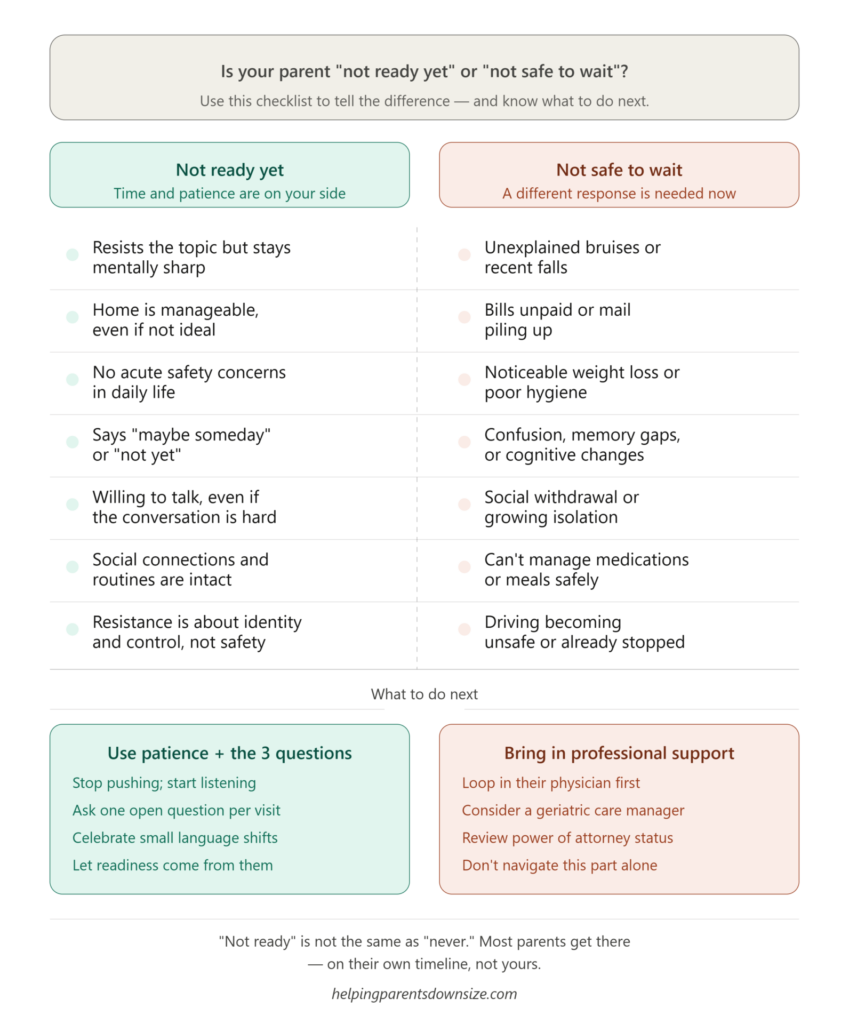
If you’re seeing signs on the right side of that checklist, the conversation changes. A few things worth doing:
- Loop in their doctor first. A physician’s concern tends to land differently than a child’s worry. It just does.
- Consider a geriatric care manager. These are professionals who assess needs and make recommendations. A neutral voice can break a deadlock that’s been going on for years. The Aging Life Care Association has a searchable directory to find one near you.
- Look into family mediation or elder care counseling, especially if the conversations have completely broken down.
- Review legal documents now, before you need them in a hurry. If you haven’t thought through your parents’ senior transition plan yet, this post is a good place to start.
Small Moves Create More Momentum Than Big Ones
Big asks create big resistance. That’s just how people work.
If the house feels like too much to talk about, try something smaller. A lot smaller.
- Ask if you can help organize one closet or one drawer. Not the whole house. Just one thing.
- Suggest a visit to a senior community framed as curiosity, not planning. “Want to just go see what it’s like? No agenda, just lunch.” You’d be surprised how often that works.
- Start with paperwork instead of belongings. Updating a beneficiary or finding an insurance document is a lot less loaded than sorting through forty years of keepsakes.
- Let them lead on what gets tackled first. A parent who chooses one box on their own terms is moving, even if slowly. That matters.
If you’re looking for a low-pressure place to start the sorting conversation, the Kitchen Table Method is exactly that. Small, contained, manageable. It keeps the emotional temperature down and gives everyone a sense of progress without the overwhelm.
Progress that feels invisible to you can be enormous for your parent. When “absolutely not” becomes “maybe someday,” that’s real movement. Don’t skip past it.
When to Bring In a Third Party
Sometimes the parent-child dynamic is simply too charged for progress. That’s not a failure. That’s just how families work sometimes.
A neutral voice can change everything. And calling one in doesn’t mean you’ve given up. It means you’re smart enough to know when you need backup.
- Geriatric care manager — can assess needs and make recommendations that carry weight coming from a professional
- Senior move manager — specializes in the logistics and emotional side of senior transitions, and they are remarkably good at it
- Estate attorney or financial advisor — sometimes a legal or financial conversation is the one that opens the door to everything else
- Therapist or counselor — especially worth considering if grief, depression, or cognitive changes are part of the picture
If you’re looking for a framework that covers all of this, from the first hard conversation to moving day, Downsize with Dignity was written specifically for families in this moment. It walks you through how to involve the right people at the right time, without turning the process into a family crisis.
Take Care of Yourself While This Plays Out
This part doesn’t get talked about enough.
The mental load of being the one who sees the risk, before anything has actually happened, is real. You are carrying worry that nobody else in the family seems to feel yet. According to AARP’s 2025 caregiving report, 63 million Americans are now family caregivers — a 45% jump in just ten years. If you’re running on empty before the move has even started, you’re not weak. You’re in very good company.
A couple of things that help:
- Give yourself permission to set a limit on how often you bring it up. Once a month is a conversation. Every visit is pressure, and pressure closes doors.
- You can love your parent deeply and still step back from a fight you cannot win right now. Those two things can both be true.
You’re not giving up by giving it some space. You’re playing a longer game.
What Comes Next
A refusal today is not a final answer. Most families get there. It just takes longer than anyone wants it to, and it almost always happens on the parent’s timeline rather than the child’s.
The families who come through this best are the ones who stopped trying to win the argument and started trying to understand the person. Your parent built a life worth holding onto. The goal was never to take them out of it. It’s to help them move into the next chapter in a way that still feels like theirs.
That’s what dignity looks like in practice.
Frequently Asked Questions
What do I do if my parent gets angry every time I bring up downsizing?
First, check the timing. Heavy conversations land harder when people are tired, rushed, or already stressed. Try a walk or a meal instead of a sit-down talk. And consider taking a break from the topic for four to six weeks before trying again. Coming back calmer, with no agenda, often changes the whole feel of it.
My parent has dementia and is refusing to move. What are my options?
This moves out of persuasion territory and into medical and legal territory. If your parent has been diagnosed with cognitive decline, their ability to make fully informed decisions may be limited. This is when things like power of attorney, physician involvement, and geriatric care management become essential. The Eldercare Locator is a free government resource that can help you find local support services by zip code. You may be in a position where the family has to make decisions on your parent’s behalf, and getting the right professionals involved early makes that process a lot less painful.
How do I get my siblings on the same page when my parent is refusing?
ne voice is almost always more effective than several. When different siblings are each bringing up the topic separately, your parent hears it as pressure coming from all directions. Try to get aligned behind closed doors first, then have one person lead the conversation. This post on sibling burnout has more on dividing this kind of labor without wearing anyone out.
Is it okay to just wait and see?
Sometimes, yes. If your parent is mentally sharp, the home is manageable, and there are no immediate safety concerns, waiting while continuing to build trust is a reasonable approach. If you’re seeing signs of cognitive decline, physical risk, or an inability to manage daily tasks, waiting gets harder to justify. The checklist above can help you figure out which side of that line you’re on.
What's the one thing I should stop saying to my parent about downsizing?
“You need to do this.” Even when it’s true, that phrasing puts you on opposite sides of the table. Try replacing it with “I want to understand what would make this feel right for you.” Same concern. Completely different conversation.